 Aert Medical
Aert Medical
Aert Medical
In the realm of medical imaging, particularly for joint assessment, a crucial question arises: "What is the difference between 0.5T and 1.5T MRI for joint imaging?" This question captures the attention of both practitioners and patients alike. According to Dr. Jane Smith, an MRI specialist at the University Medical Center, "The strength of the MRI magnet can significantly impact the quality of the images obtained." Her expertise highlights the importance of understanding different MRI strengths.
When considering 0.5T versus 1.5T MRI, the distinction plays a vital role in diagnosing joint conditions. The 1.5T MRI provides clearer images with a higher resolution. This is essential for detecting subtle joint issues. In contrast, the 0.5T MRI, while adequate for certain cases, may miss critical details. The choice of MRI strength hinges on numerous factors, including the patient's condition and the specific diagnostic requirements.
While many practitioners advocate for the 1.5T option, one must reflect on its implications. The cost and availability of 1.5T machines can be a barrier. Therefore, understanding both types is valuable in making informed decisions. Ultimately, the question remains: how do these differences directly influence patient care and outcomes?
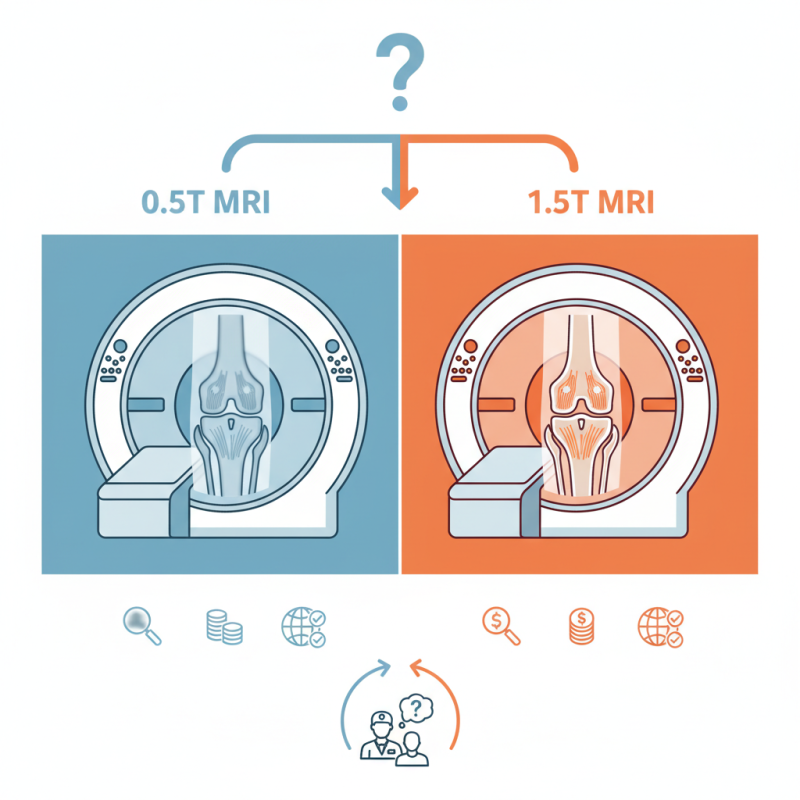
MRI machines are critical for diagnosing joint issues. The two common strengths are 0.5T and 1.5T. The "T" signifies Tesla, a unit of magnetic strength. A 1.5T MRI provides better image resolution. It captures more detailed information. This is especially important for diagnosing conditions like tears or inflammation.
Studies show that 1.5T MRIs can detect subtle injuries that 0.5T might miss. For example, a report from the American Journal of Roentgenology indicates that 1.5T scans can identify 30% more ligament tears. In joint imaging, clarity matters greatly. Higher strength yields clearer images, which aids in detection and treatment planning.
However, 0.5T MRIs are not without merit. They are often more accessible due to cost and availability. Many patients may feel more comfortable in open 0.5T machines. Some individuals experience discomfort in closed environments. While the image quality may vary, the accessibility of 0.5T systems cannot be overlooked. These machines can still provide valuable insights into joint conditions.
| Feature | 0.5T MRI | 1.5T MRI |
|---|---|---|
| Magnetic Field Strength | 0.5 Tesla | 1.5 Tesla |
| Image Resolution | Lower Resolution | Higher Resolution |
| Scan Time | Longer | Shorter |
| Patient Comfort | Generally Higher | Can Feel Confined |
| Cost | Lower | Higher |
| Applications for Joint Imaging | Basic assessments | Detailed evaluations |
: MRI technology is crucial for accurately visualizing soft tissues and ligaments in joint imaging.
The magnetic field strength significantly impacts image resolution; higher strength provides clearer images.
The most common MRI strengths are 0.5T and 1.5T machines.
A 0.5T MRI may be more accessible and comfortable for patients with anxiety in confined spaces.
A 1.5T MRI offers superior resolution, allowing better visualization of small lesions and joint structures.
Yes, while less precise, a 0.5T MRI can still reveal significant abnormalities and help in diagnosis.
Patients should understand the differences in magnetic strengths and discuss options with their healthcare provider.
Choosing the appropriate MRI can impact the accuracy of diagnoses and the timing of treatment.
Factors include type of joint injury, patient comfort, and availability of the MRI machine.
Yes, each type has pros and cons, highlighting the need for thoughtful decision-making.
The article "What is the difference between 0.5T and 1.5T MRI for joint imaging?" delves into the fundamental differences between two types of MRI machines based on their magnetic field strength. MRI technology operates on the principle that higher magnetic fields (like those found in 1.5T machines) generally provide better image quality compared to lower fields (0.5T). This difference has significant implications for joint imaging, where clarity and detail are crucial for accurate diagnosis.
The article further explores when to use each type of MRI in clinical settings, emphasizing the relevance of magnetic field strength in ensuring diagnostic efficacy. A comparative analysis of image quality reveals that while 1.5T MRI scans tend to offer superior detail, 0.5T machines can still be useful in specific situations. Overall, understanding these distinctions aids healthcare professionals in making informed decisions regarding joint imaging options.
